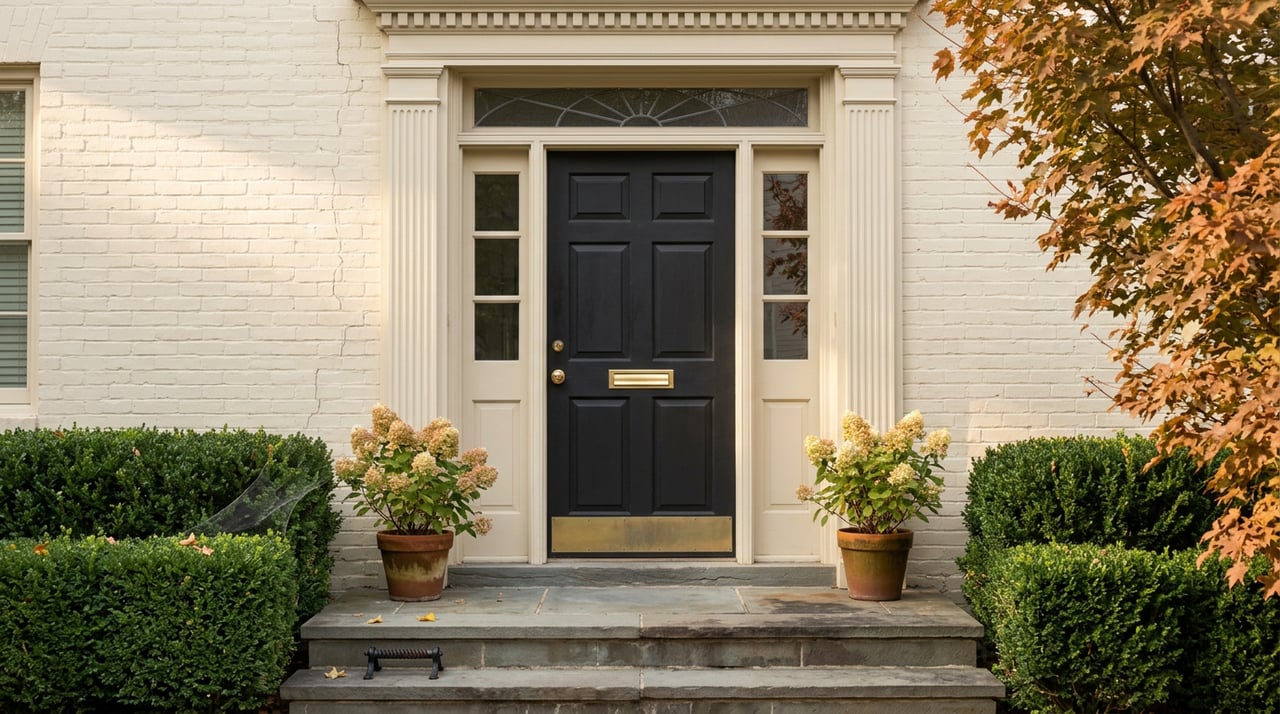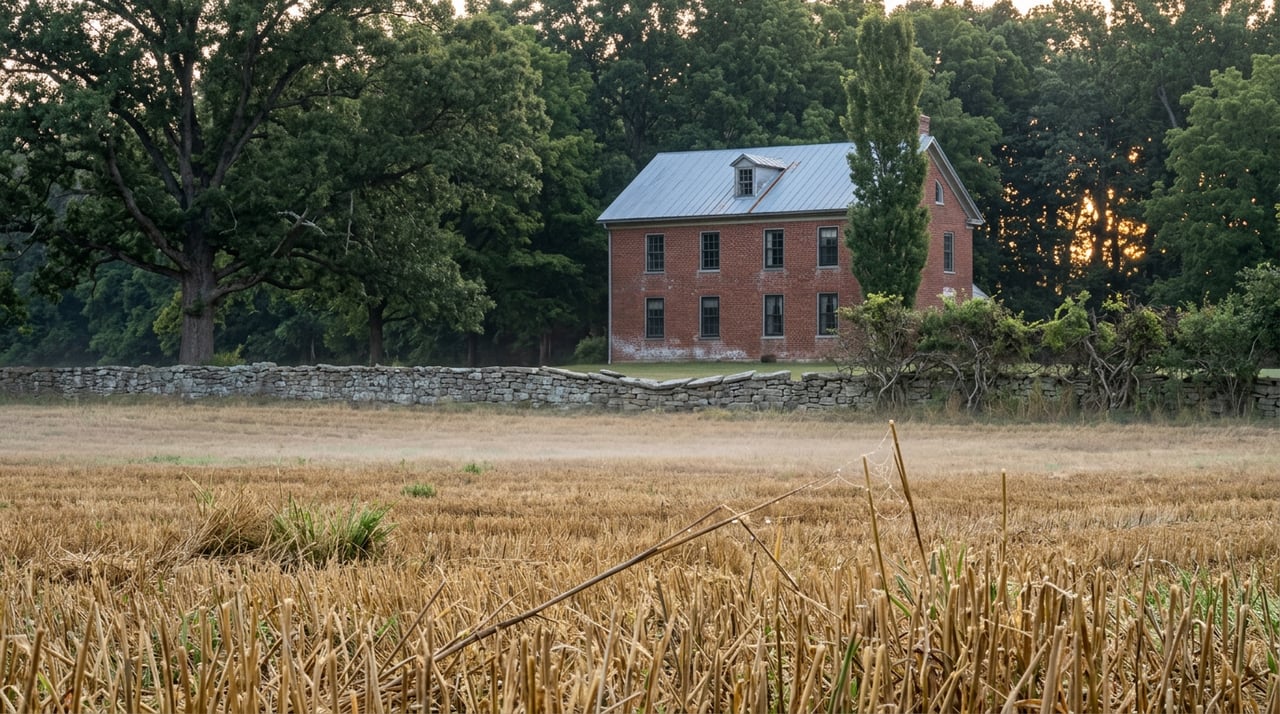
In January 2025, a family named Stettinius gave away part of their property in the heart of Upperville. Not sold it. Gave it, in the form of a conservation easement recorded on 8.654 acres along Route 50 across from the Upperville Post Office. The parcel holds the Cranford House, a certified historic building dating to 1810, and sits inside both the Upperville Historic District and the Unison Battlefield Historic District, ground that saw cavalry fighting in June 1863 as Confederate forces screened Lee's march toward Gettysburg. Before the easement, county zoning would have allowed the land to be split into nine lots. After it, that possibility is gone, permanently, recorded against the deed, binding every future owner.
That single transaction tells you more about how land actually prices out around Upperville than any per-acre average on a listing sheet. A buyer comparing two 20-acre parcels here is not necessarily comparing two versions of the same product. One may carry full development rights. The other may have already had its subdivision potential retired, sometimes decades ago, sometimes last year, and that difference rarely shows up as a headline number.
The Acreage Figure Is Doing Less Work Than It Looks Like
A conservation easement is a private legal agreement, recorded with the county, in which a landowner permanently limits what can be built or divided on a property in exchange for tax benefits and the certainty that the land stays intact. The owner still owns it, still farms it, still hunts it, still sells it. What changes is the menu of future uses. Once recorded, an easement runs with the land forever, regardless of who buys it next.
Three organizations do most of this work in the Upperville area. The Piedmont Environmental Council has helped landowners permanently protect more than 430,000 acres of rural land across the region to date. The Land Trust of Virginia, headquartered near Middleburg, holds easements concentrated most heavily in Loudoun and Fauquier counties. The Virginia Outdoors Foundation protects more than 850,000 acres statewide, making it one of the largest land conservation holders in the country. Any one of them may already sit on the title history of a property you are touring, and none of that shows up in a standard listing description unless you go looking for it.
The County Line Changes the Math
Cross the Bull Run Mountains from Loudoun into Fauquier and the rural zoning rules change underneath you, even though the scenery does not.
| Jurisdiction | Zoning category | Minimum lot size |
|---|---|---|
| Fauquier County | RA, Rural Agricultural | 25 acres |
| Fauquier County | RC, Rural Conservation | 50 acres |
| Loudoun County | AR-1 | 3 acres |
| Loudoun County | AR-2 | 5 acres |
That gap is not trivial. A 25-acre tract in Fauquier's RA zone is close to the smallest legal rural division the county allows. The same 25 acres just across the county line in Loudoun could theoretically support several buildable lots under AR-1. RC zoning, Fauquier's most restrictive category, gets applied to environmentally sensitive ground, including parts of the Bull Run Mountain corridor and the upper Rappahannock watershed, and its 50-acre minimum is enforced strictly. On top of the base zoning, Fauquier layers historic district overlays with Architectural Review Board authority in Warrenton, Upperville village, and The Plains, meaning exterior changes, additions, and new construction inside those boundaries face design review before they face a building permit.
None of this means Upperville land is harder to buy. It means the acreage number alone cannot tell you what the county will let you do with it, and an easement on top of that zoning can narrow the picture further still.
An easement does not lower what a farm is worth as a farm. It lowers what a farm is worth as nine lots.
Why Owners Choose to Give Up the Subdivision Right
The Stettinius decision was not an isolated act of generosity. Virginia's land preservation tax credit gives landowners a real financial reason to trade subdivision rights for permanence. If a certified appraiser determines that a $500,000 parcel is worth $300,000 once its subdivision rights are extinguished, the $200,000 difference is the easement's appraised value, and the owner can claim 40 percent of that value in state income tax credits, roughly $80,000 in this example. Landowners who cannot use the full credit themselves can sell it. Add federal income and estate tax benefits on top, and the incentive to lock land in place gets stronger the more valuable the underlying subdivision rights would have been.
This is the mechanism sitting behind the Cranford House parcel. A property fronting a designated Virginia Byway, directly across from the post office, inside a historic district, was worth meaningfully more sliced into nine building lots than it was as one intact 8.654-acre tract. The tax credit made giving up that difference financially rational rather than purely sentimental, and it is a big part of why the village core still reads as a single continuous streetscape of early homes under mature trees rather than a subdivision.
What This Looks Like in an Actual Listing
Easement-protected land is not a fringe category near Upperville. It shows up regularly at the high end of the market. One 365-acre property currently marketed in the area sits under a Land Trust of Virginia easement, within Piedmont Hunt territory, and includes a Cedar of Lebanon tree believed to be the largest specimen of its kind in Virginia, estimated at roughly 250 years old. The easement does not appear to be depressing demand for a property like that. It is part of the pitch: permanence, privacy, and a landscape guaranteed to stay exactly as it looks in the listing photos for as long as anyone owns it.
That helps explain some of the spread in Upperville's current market. As of June 2026, homes listed for sale in the area ranged from $548,000 to $11,200,000, with a median list price around $2.62 million. Square footage and finish level explain part of that range. Easement status, historic district overlay, and remaining subdivision rights explain more of it than most buyers assume when they are still comparing listings on price per acre.
Questions to Ask Before You Fall for the Acreage
A few checks turn easement status from a surprise at closing into a known quantity before you write an offer.
- Pull the recorded easement, not a summary of it, from Fauquier County land records. Summaries can omit reserved rights that matter to you.
- Ask which organization holds the easement. PEC, the Land Trust of Virginia, VOF, and the Virginia Department of Historic Resources all write terms differently, and some retain more flexibility for future owners than others.
- Find out what rights were reserved. Many easements still permit agriculture, timber harvest, hunting, and even one or two future building sites. Very few block every future use outright.
- Confirm whether the parcel sits inside the Upperville Historic District boundary, which brings Architectural Review Board authority into any exterior renovation or new construction, separate from the easement question entirely.
- Ask your agent or attorney whether the property abuts RA or RC zoning, since a neighboring parcel's minimum lot size affects what could eventually be built next door, easement or not.
The Easement Is Information, Not a Warning
None of this is a reason to avoid land near Upperville, and it is not a caution flag either. An easement is simply a fact about the property that happens to matter more here than in most markets, because so much of the ground around this village has already had that decision made for it, sometimes generations ago, sometimes within the past year. Buyers who ask the right question early, specifically what has already been decided about this land, end up negotiating from a position of knowledge instead of discovering the answer at the courthouse after the fact.
If you are weighing a parcel near Upperville, or trying to understand why two properties with identical acreage carry very different prices, Allen Real Estate has spent decades reading exactly this kind of fine print across Fauquier County. Reach out and we will walk the actual recorded documents with you before you fall for the view.